Skip to content
The Opponent

Training books for conversations at work

Practice the conversation before it counts.

An AI plays the other side, working from a brief you haven't read. Then it scores you on a fixed rubric, and the book shows what was possible.

  • Sample case at no cost
  • No sign-up on this site
  • Works with ChatGPT, Claude, or Gemini
Book 1: Negotiate 30 practice cases · in the works About the book
An online printer quoted us $16,500. Can you match it?
Marketing director on the phone, sample case 3
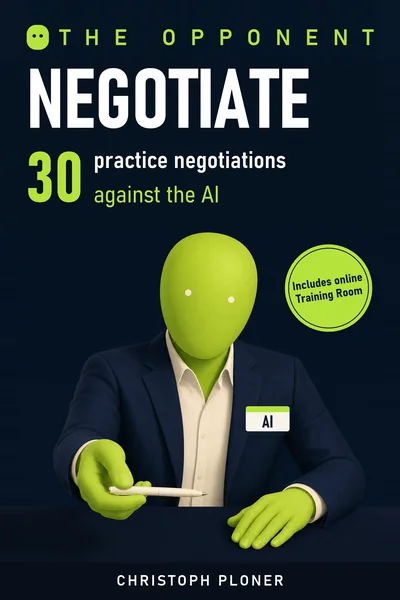
The opponent from Negotiate: a figure in a suit with a colored head, two dot eyes, and an AI name tag.

Book 1: Negotiate

Explained in one minute

How a case plays out

Read the transcript

Sound familiar? The meeting's over, and only now do you know what you should have said. So practice before it counts. An AI like ChatGPT, Claude, or Gemini plays the other side, working from a hidden brief you haven't read. Here's how it works, with one of the free sample cases. Pick your AI and click “Start case.” The hidden brief is copied to your clipboard, unread. Paste it into a new chat. Then you negotiate. Here, the painter can't start until March, and you need the office done before tax season. Type SCORE, and the exercise ends. The AI reveals what it was hiding, then scores you on six criteria, quoting your own words. The book has ten techniques and thirty cases across five levels, each with a debrief. And all of it works without AI, too. Play a sample case now, at theopponentbooks.com.
Start the case, negotiate with the AI, type SCORE. Shown with Case 7, one of the free sample cases, using a real test conversation, shortened.

Pick a sample case

How it works

Three steps. One conversation that pushes back.

  1. 1 Start the case

    One tap copies the hidden brief. Paste it into your AI and send it without reading it. Now only your counterpart knows what's behind the case.

  2. 2 Talk it through

    In ChatGPT, Claude, or Gemini, typed or spoken. The AI is instructed to stay in character, even when you push. If it slips, type RESTART.

  3. 3 Get your score

    Type SCORE: six criteria, 1 to 5 points each, backed by quotes from your own messages. The book shows what was possible.

3 of 30 cases from Negotiate

Three cases from the book. Right now, no sign-up.

From a friendly client to a professional buyer. Pick one, start it, and type SCORE at the end.

Which AI are you using?

All three have a free version, which needs an account. In our tests of the German and English editions, it was enough for one or two cases at a time; for long sessions or voice, a paid plan helps. Why

Case 7 Level 1 of 5: Cooperative

The Slow Season

Owner, painting company · about 10 minutes

Her quote is $5,800, starting in early March. You need it done by February 12.

Her quote
$5,800
Your goal
$5,250
Other painter
$6,400

Copies the hidden brief for ChatGPT without showing it.

Case 3 Level 2 of 5: Friendly but firm

The Spring Catalog

Marketing director Ortiz (Tallwater Outdoor) · about 10 minutes

Your client got an online quote of $16,500. You quoted $18,400.

Your quote
$18,400
Online quote
$16,500
Your limit
$17,480

Copies the hidden brief for ChatGPT without showing it.

Case 28 Level 4 of 5: Pro

The Renewal

Strategic sourcing manager Mehta (Terhaven) · about 20 minutes

A rival quotes $114,000 a year. Your contract pays $140,000 and ends March 31.

Your contract
$140,000
Rival quote
$114,000
Your floor
$128,000

Copies the hidden brief for ChatGPT without showing it.

for ChatGPT · change

Case 7

The Slow Season

Owner, CPA firm (buying) · Level 1 of 5 · Cooperative · about 10 minutes

Practice scenario. All companies and people are fictional.

Which AI are you using?

The situation

You own a seven-person CPA firm in Minneapolis. Your 2,000-square-foot office needs painting before a new staff accountant starts in mid-February. Then tax season hits, and nobody wants painters around. Every office has full file cabinets.

On the first Monday in January, Rosa Lindqvist of Lindqvist Painting LLC walks through with you, then writes up her quote: $5,800, two painters, four days, furniture moving included. Then she adds:

February we're on a new build, the whole crew. Earliest I can get you in is early March.

Your goal

$5,250, and done by February 12. At the end, type: SCORE. In the deal, lower is better for me. My goal was $5,250, done by February 12. My limit was $5,800.

Your numbers

Her quote
$5,800, start in early March
Your ceiling (walk-away point)
$5,800, her quote
Your best alternative
Another painter: $6,400, from early February, evenings and a weekend so you stay open. $600 more, but in time.

What you know about her

  • Her van says "Exterior & Interior Painting." It's been below zero since New Year's.
  • She asks whether the file cabinets have to stay put.
  • She photographs two offices with her phone, "for my files."
  • The quote says: "Material pricing good for orders placed by January 31."
  • She took over from her father two years ago.

What you can trade

What you can giveWhat it costs you
A January start, daytime hoursa few days of painters around
Your staff clear the cabinets and move furniture the Saturday beforeabout $350 in overtime
Photos of the finished offices for her websitenothing
Payment at the final walk-through, not in 30 daysunder $20 in interest

What to expect

Level 1: friendly. Rosa tells you what matters to her if you ask specifically, discounts only in exchange, and has one objection.

Before you speak (5 minutes, no AI)

  1. Will you mention the other quote? Write the sentence, or your reason not to.
  2. What question tells you how busy her January is?
  3. Write an if-then offer: a date, a price, and one trade from your list.
for ChatGPT · change

Case 3

The Spring Catalog

Account manager, commercial printer · Level 2 of 5 · Friendly but firm · about 10 minutes

Practice scenario. All companies and people are fictional.

Which AI are you using?

The situation

You're an account manager at Marlow & Finch Printing, a commercial printer with 40 employees.

Tallwater Outdoor, an outdoor gear company, has printed its spring catalog with you for three years: 64 pages, 20,000 copies. A week ago you quoted this year's run at $18,400, delivered. That's last year's price, even though your paper costs have gone up.

Today Megan Ortiz, Tallwater's marketing director, calls:

An online printer quoted us $16,500. Can you match it?

Your goal

Keep the job, ideally at $18,400, and give something only in exchange for something.

Your numbers

Your quote
$18,400, delivered (92 cents a copy)
Your walk-away point
$17,480 (your sales manager approved up to 5 percent off)
Your best alternative
No deal. Your presses are 70 percent booked in February, March is full, and nothing else is lined up to fill February.

What you know about her

  • Megan has been your contact for two years. Always friendly.
  • The catalogs are handed out at an industry trade show on March 12.
  • Last year they arrived four days before the show, because Tallwater signed off on the final proof late.
  • Tallwater has had a new CEO since October.
  • When she sent the files in early January, Megan wrote:

Main thing this year: more breathing room before the show.

What you can trade

What you can giveWhat it costs you
A firm delivery date of February 19, in writingnothing; the press is open that week
1,000 extra copies from the same runabout $380
Payment terms of net 60 instead of net 30little; you get paid a month later
A free hard-copy color proof (normally $240)$240

What to expect

Level 2: friendly, one clear demand, one argument (the competition). Megan gives in when your offer works for her.

Before you speak (5 minutes, no AI)

  1. What is your first sentence after "$16,500," word for word, before you talk about money?
  2. Which two questions tell you what matters to her besides price?
  3. Write one if-then offer from your trade list that costs you $400 or less.
for ChatGPT · change

Case 28

The Renewal

Key account manager, IT services · Level 4 of 5 · Pro · about 20 minutes

Practice scenario. All companies and people are fictional.

Which AI are you using?

The situation

You're the key account manager at Kellmont IT Services Inc. in Dallas, a managed services provider with 60 employees.

For five years, Kellmont has run the warehouse management system and network at Terhaven Supply Co.'s six branches, with 24/7 incident response and a one-hour response time. The contract is $140,000 a year and ends March 31. Your renewal offer: three years on the same terms.

From: Arjun Mehta, Strategic Sourcing, Terhaven Supply Co. (yesterday) We have a quote from Marrowfield Systems at $114,000 a year.

Our CFO has approved $117,000 for this service. Please send your best and final offer by noon Friday. I'm available for a 30-minute video call Wednesday at 10 a.m. if you have questions.

It's Wednesday, 9:50 a.m.

Your goal

A renewal with 24/7 incident response, at least $131,000 a year, for at least three years. At the end, type: SCORE. In the deal, higher is better for me. My goal was at least $131,000 a year for at least 3 years, for full 24/7 coverage with a one-hour response. My limit was $128,000 for that service.

Your numbers

  • Your floor for the same service: $128,000. Your VP of sales has signed off that far.
  • A service option: on-call coverage nights and weekends, with a four-hour response instead of one hour. It saves Kellmont $13,000 a year.
  • Your best alternative without a deal: Terhaven is 11 percent of your revenue. Two technicians would have no work from April. A new client you're talking to won't need capacity before October.

What you know about him

  • Arjun has been at Terhaven for eight months. Before that, he bought for an auto parts supplier.
  • In the fall, Terhaven's distribution center manager, Denise Fowler, thanked your team in writing: an outage the night before a big shipment was fixed in 40 minutes.
  • Marrowfield would need time to ramp up. With six branches, that means months of transition.
  • You don't know what Marrowfield's quote includes.
  • Your contract lets Kellmont raise the price up to 3 percent a year. In five years, you never did.

What to expect

Level 4: a prepared pro. He anchors low, sets deadlines, points to a higher authority, and threatens to walk away. He won't volunteer his interests.

Before you speak (10 minutes, no AI)

  1. The email holds at least three tactics. Name each one, with the sentence you'll answer it with on the call.
  2. Your trade list: three things you can give, three you can ask for, each with what it's worth to both sides.

(blank table, 4 columns, 3 rows) Column heads: What you can give | Costs you | What you ask for | Worth to you

  1. Where is your walk-away point? With what sentence do you postpone instead of going below it?
  • Paid AI plan? In our tests of the German and English editions, the free versions handled one or two cases at a time; for long sessions or voice, a paid plan helps (why).
  • No AI at all? The book works on its own, or with a colleague who reads the hidden brief.
  • Your data: your practice data stays in your browser. Don't type real names or company details into the AI.
  • The commands PAUSE, RESTART, and SCORE: How to Practice.

Read it, or practice it

The difference is one sentence

Reading tells you what you should say. Practice gets you to say it. Play first, then reveal: the turning point of the sample case, word for word from its debrief. The strong move gives away what the case is about.

  1. They say

    “We got a quote from an online printer for $16,500. That's almost $2,000 less than yours. Can you match it?”

    Weak move

    “Oh, that's a lot. I could probably do $17,500.”

    Show strong move

    Strong move

    “Thanks for calling me before you decide. So I can compare apples to apples, what does their quote include? Turnaround time, a proof, a firm delivery date?”

    Case 3, level 2 · Take the demand seriously without meeting it, then ask (Techniques 4 and 6)

Tested, with limits

What we tested, and what we haven't yet

  1. More than 160 recorded test conversations in English

    All 30 cases, with models from OpenAI, Google, and Anthropic, the companies behind ChatGPT, Gemini, and Claude. The German edition went through the same test first.

  2. A second AI tried to break it

    It played the learner: sometimes a pushover, sometimes asking for the instructions, calling the counterpart "just an AI," or asking it to be nice. Where the rules broke, they were rewritten.

  3. Not tested yet

    The phone apps and English voice mode. The free versions on a computer were tested in English in November 2026.

It can still slip. If it does, type RESTART or open a new chat.

Questions

Before you start

Do I need a paid AI plan?

The conversations are kept short, and every case works without any AI. In our tests of the German and English editions, the free versions were enough for one or two cases at a time. If you practice a lot in one sitting or by voice, a paid plan helps, because the free versions can cap you. Free versions may limit messages and voice time, and some apps switch to a smaller model after many messages. Paid plans aren't unlimited either, but they allow more.

Can't I just ask ChatGPT to role-play?

You can. Without a brief, a chatbot tends to agree with you and give in early. Each case here adds a hidden brief with fixed limits, rules we tested against exactly that problem, a fixed rubric, and a debrief.

Does it work without AI?

Yes. Every case has the situation, a prep task, and a debrief in the book. With a partner, your partner reads the hidden brief and plays the other side. The AI makes practice more realistic; it isn't a requirement.

Is my conversation private?

Your practice data and your log stay in your browser; this site doesn't collect them. What you type into the AI goes to that company, under its terms. So no real names, customer data, or company details.

When are the books out?

There's no date yet, and we won't name one until it's real. Negotiate comes first. Until then, the sample case is here to try.

Who's behind this?

Christoph Ploner. He spent eleven years negotiating new locations for an international fitness company, then moved into sales and business development. More on the About page.

Christoph Ploner

The author

Christoph Ploner

Christoph Ploner spent eleven years finding, vetting, and signing new locations for an international fitness company. He acquired fourteen sites in Austria and Germany, some of them over 20,000 square feet, negotiating with brokers and developers until the lease was signed. He then moved into sales and business development, where proposals and negotiation are part of the craft.

He uses AI every day and writes the German nonfiction series KI-Trumpf. In The Opponent, the AI takes the other side of the table. It doesn't replace experience. But it lets you practice before a conversation counts.

More about the author

Ready for your first case?

About ten minutes. The sample case costs nothing, and there is no sign-up on this site.