Skip to content
The Opponent

Book 1

Negotiate

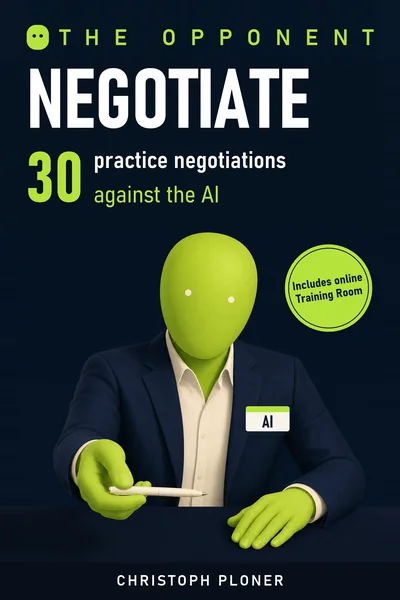
Cover of The Opponent: Negotiate by Christoph Ploner. A figure in a navy suit with a lime-green head, two dot eyes, and an AI name tag holds out a pen across a table.

Draft cover

30 negotiations to practice against the AI before the real one.

A negotiation skills workbook for anyone who negotiates at work over prices, budgets, salary, rates, or contracts: sales, purchasing, project leads, freelancers.

Try a case first In the works

30 practice cases · 10 techniques · levels 1 to 5 · with online Training Room

The English edition is written for American workplaces, adapted from the German original, and is in the works.

See it in action

One case in a minute

Read the transcript

Sound familiar? The meeting's over, and only now do you know what you should have said. So practice before it counts. An AI like ChatGPT, Claude, or Gemini plays the other side, working from a hidden brief you haven't read. Here's how it works, with one of the free sample cases. Pick your AI and click “Start case.” The hidden brief is copied to your clipboard, unread. Paste it into a new chat. Then you negotiate. Here, the painter can't start until March, and you need the office done before tax season. Type SCORE, and the exercise ends. The AI reveals what it was hiding, then scores you on six criteria, quoting your own words. The book has ten techniques and thirty cases across five levels, each with a debrief. And all of it works without AI, too. Play a sample case now, at theopponentbooks.com.

How you practice with the book: start a case, negotiate with the AI, type SCORE. Then the debrief in the book shows what was possible.

Try the sample case

The problem

The right line comes to you on the drive home

You've read a book on negotiation and underlined the good lines. Then a client calls: an online printer will do the job for $16,500 instead of your $18,400. Can you match it? Not one underlined line comes to mind.

You learn to negotiate the way you learn to drive: behind the wheel. For most people, the only practice is the real conversation, with real money on the table.

What's different here

Read. Think. Talk. Score.

  1. 1 Read

    One technique in about five pages: when you need it, how to do it, which sentences work.

  2. 2 Think

    Before each case, a prep task on paper, no AI: your first sentence, your questions, your limit.

  3. 3 Talk

    The AI plays your counterpart from a brief you don't read. Typed or spoken.

  4. 4 Score

    SCORE: six criteria, backed by your own words. Then the debrief in the book.

Try it instead of taking our word for it

A case from the book. Right now.

No sign-up on this site, the full case as written for the book. You need ChatGPT, Claude, or Gemini. Ten minutes, and you'll know whether this way of practicing works for you.

Which AI are you using?

All three have a free version, which needs an account. In our tests of the German and English editions, it was enough for one or two cases at a time; for long sessions or voice, a paid plan helps. Why

Case 3 Level 2 of 5: Friendly but firm

The Spring Catalog

Marketing director Ortiz (Tallwater Outdoor) · about 10 minutes

Your client got an online quote of $16,500. You quoted $18,400.

Your quote
$18,400
Online quote
$16,500
Your limit
$17,480

Copies the hidden brief for ChatGPT without showing it.

for ChatGPT · change

Case 3

The Spring Catalog

Account manager, commercial printer · Level 2 of 5 · Friendly but firm · about 10 minutes

Practice scenario. All companies and people are fictional.

Which AI are you using?

The situation

You're an account manager at Marlow & Finch Printing, a commercial printer with 40 employees.

Tallwater Outdoor, an outdoor gear company, has printed its spring catalog with you for three years: 64 pages, 20,000 copies. A week ago you quoted this year's run at $18,400, delivered. That's last year's price, even though your paper costs have gone up.

Today Megan Ortiz, Tallwater's marketing director, calls:

An online printer quoted us $16,500. Can you match it?

Your goal

Keep the job, ideally at $18,400, and give something only in exchange for something.

Your numbers

Your quote
$18,400, delivered (92 cents a copy)
Your walk-away point
$17,480 (your sales manager approved up to 5 percent off)
Your best alternative
No deal. Your presses are 70 percent booked in February, March is full, and nothing else is lined up to fill February.

What you know about her

  • Megan has been your contact for two years. Always friendly.
  • The catalogs are handed out at an industry trade show on March 12.
  • Last year they arrived four days before the show, because Tallwater signed off on the final proof late.
  • Tallwater has had a new CEO since October.
  • When she sent the files in early January, Megan wrote:

Main thing this year: more breathing room before the show.

What you can trade

What you can giveWhat it costs you
A firm delivery date of February 19, in writingnothing; the press is open that week
1,000 extra copies from the same runabout $380
Payment terms of net 60 instead of net 30little; you get paid a month later
A free hard-copy color proof (normally $240)$240

What to expect

Level 2: friendly, one clear demand, one argument (the competition). Megan gives in when your offer works for her.

Before you speak (5 minutes, no AI)

  1. What is your first sentence after "$16,500," word for word, before you talk about money?
  2. Which two questions tell you what matters to her besides price?
  3. Write one if-then offer from your trade list that costs you $400 or less.

Play first, then reveal

The difference is one sentence

The turning point of the sample case. The weak and the strong move are word for word from the debrief in the book. The strong move gives away what the case is about, so play first.

  1. They say

    “We got a quote from an online printer for $16,500. That's almost $2,000 less than yours. Can you match it?”

    Weak move

    “Oh, that's a lot. I could probably do $17,500.”

    Show strong move

    Strong move

    “Thanks for calling me before you decide. So I can compare apples to apples, what does their quote include? Turnaround time, a proof, a firm delivery date?”

    Case 3, level 2 · Take the demand seriously without meeting it, then ask (Techniques 4 and 6)

Cover of The Opponent: Negotiate by Christoph Ploner. A figure in a navy suit with a lime-green head, two dot eyes, and an AI name tag holds out a pen across a table.

The book: Negotiate

  • Paperback and ebook (planned)
  • 10 techniques
  • 30 cases with debriefs
  • Book code for all 30 hidden briefs in the Training Room

In the works

Try a case first

What's inside

A training plan, step by step

Techniques
10
Techniques
Practice cases
30
Practice cases
Rounds
5
Rounds
Levels
1 to 5
Levels
See five rounds, ten techniques

Five rounds, getting harder

  1. 1

    Holding your price

    From a friendly price talk to a job you're better off turning down.

  2. 2

    Buying

    The same techniques from the buyer's side: price increases, complaints, a sole supplier.

  3. 3

    Your own terms

    Your rate, a raise, usage rights, a promotion under pressure.

  4. 4

    Projects

    Budget, people, deadlines, and change requests, often with colleagues you'll work with again tomorrow.

  5. 5

    Contracts and tough opponents

    Terms, contract length, professional buyers, two opponents at once.

Levels from 1 (Cooperative) to 5 (Worst case). Every case states its level.

Ten techniques

  1. 1Goal, Walk-Away Point, and Best Alternative
  2. 2The Anchor, or Making the First Offer
  3. 3Responding to an Anchor
  4. 4Never Give Without Getting
  5. 5Pacing Your Concessions
  6. 6Asking About Interests
  7. 7Packages and Trade Value
  8. 8Silence and the Recap
  9. 9Spotting and Defusing Tactics
  10. 10Close, Confirm, or Postpone

Look inside · excerpt from the English draft

Technique 2: The Anchor, or Making the First Offer

The core: Whoever names the first number sets the range the negotiation happens in.

So your first offer sits above your goal (below it when you're buying), as high as you can justify line by line, stated as an exact figure, with no apology.

Read on

When you need it

Whenever you write a quote or name a number in a conversation, especially when the other side asks for one:

  • “Ballpark, what are we looking at?”
  • “Just give me your best price.”
  • “What are your salary expectations?”
  • “Why don't you throw out a number?”
The book continues with: why it works, how to do it (a worked example with numbers), lines to use, common mistakes, the limits of the technique, and a pen-and-paper exercise. Draft wording of the English edition; it may still change.

Is this your book?

Yes, if

  • You negotiate at work, whether in sales, purchasing, on a project, or for yourself.
  • You want to practice until the lines come out right, not just understand them.
  • You have half an hour per case and access to ChatGPT, Claude, or Gemini.

Probably not, if

  • You want stories about famous negotiators. There are better books for that.
  • You want tricks for taking people for a ride. No technique here requires deception.
  • You never want to practice with an AI. The book works without it, but you'd be using half of it.

Questions

Before you ask

Do I need a paid AI plan?

The conversations are kept short, and every case works without any AI. In our tests of the German and English editions, the free versions were enough for one or two cases at a time. If you practice a lot in one sitting or by voice, a paid plan helps, because the free versions can cap you. Free versions may limit messages and voice time, and some apps switch to a smaller model after many messages. Paid plans aren't unlimited either, but they allow more. More under How to Practice.

Which AI should I use?

Any of the three. Pick your AI and the button copies the brief. If you like, play the same case against two of them and compare.

Does it work on my phone, and can I talk instead of type?

The site works in your phone's browser, but we haven't tested the ChatGPT, Claude, and Gemini phone apps yet. To talk: paste the brief into the text chat and send it, then start voice mode in the same chat. We haven't yet tested how reliably each app recognizes the commands when spoken, so type them if in doubt.

What if the AI breaks character?

It can happen. The brief instructs the AI to stay in character, even when you push. If it slips, type RESTART or open a new chat. The English briefs were tested in more than 160 recorded conversations with models from OpenAI, Google, and Anthropic, and rewritten where they broke. Rule of the series: no case goes into a book until it has held up with at least two AIs.

Does the book work without AI?

Yes. Every case has the situation, a prep task, and a debrief in the book. With a partner, your partner reads the hidden brief and plays the other side. The AI makes practice more realistic; it isn't a requirement.

Is my conversation private?

Your practice data and your log stay in your browser; this site doesn't collect them. What you type into the AI goes to that company, under its terms, so no real names or company details.

Can't I just ask ChatGPT to role-play?

You can. Without a brief, a chatbot tends to agree with you and give in early. Each case here adds a hidden brief with fixed limits, rules we tested against exactly that problem, a fixed rubric, and a debrief.

Is this a prompt book?

No. The prompt for each case is one short box. Most of the book is techniques with examples and exercises, and cases with prep tasks and debriefs.

Will it tell me what rate or salary to ask for?

No. It trains how you name a number, hold it, and trade, not which number is right for you. It isn't legal, HR, or salary advice.

When is the English edition out?

There's no date yet, and we won't name one until it's real. Until then, the sample case is here.

Christoph Ploner

The author

Christoph Ploner

Christoph Ploner spent eleven years finding, vetting, and signing new locations for an international fitness company. He acquired fourteen sites in Austria and Germany, some of them over 20,000 square feet, negotiating with brokers and developers until the lease was signed. He then moved into sales and business development, where proposals and negotiation are part of the craft.

He uses AI every day and writes the German nonfiction series KI-Trumpf. In The Opponent, the AI takes the other side of the table. It doesn't replace experience. But it lets you practice before a conversation counts.

More about the author

In the works

Negotiate: practice first, decide later

There's no release date yet. In the meantime, you can play the sample case.

Try a case first